The AEO Report You Can Actually Put in Front of a Client
The problem with most "AI visibility" deliverables
Your client asks if they show up in ChatGPT. You run some free grader, get a score, and now you're staring at a number with no idea what produced it or what to do about it. A score isn't a deliverable. You can't invoice for a number that moves on its own the next time someone reruns the check.
What you can invoice for is a report that says, in plain language, here's what's broken on your client's site and here's exactly how to fix it. That's the difference between a grader and an audit — and it's the whole reason AEO Checker exists as a one-time report instead of a dashboard you log into.
What's actually in the PDF
Every tier — Quick Scan, Full Audit, Deep Scan — delivers the same core report structure. The tiers differ in how many pages get crawled (up to 20, 50, or 100), not in what the report contains.
Score summary and letter grade. One page, up front. Six module scores rolled into a total, with an A–F grade. This is the page you screenshot for the client email.
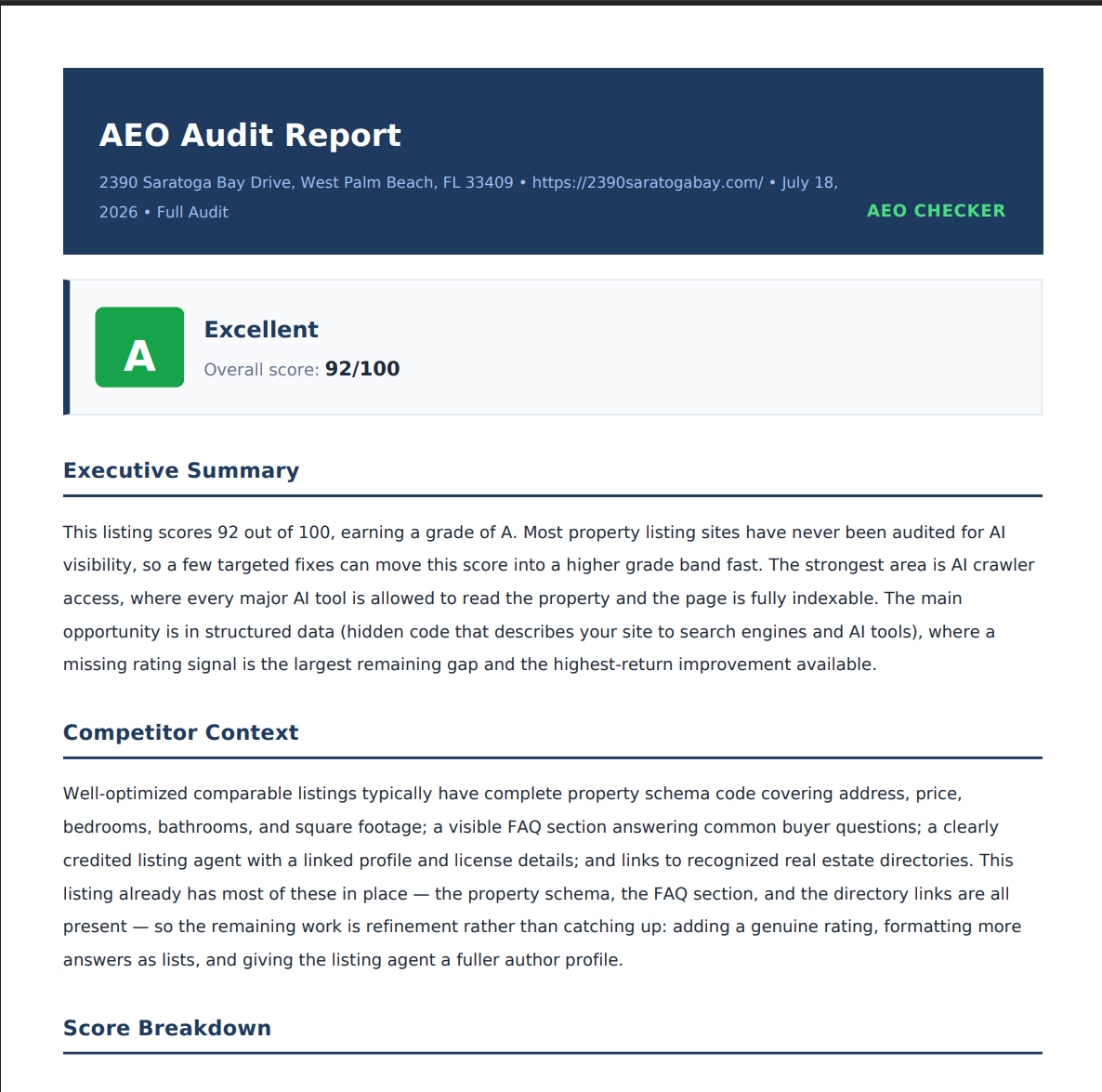
A plain-English executive summary. Three or four sentences on where the site stands and what's putting it most at risk with AI answer engines. No jargon, no hedging — written so a business owner who has never heard of structured data can still follow it.
Top 3 Priority Fixes. Not a wall of 40 issues — the three that move the needle most, each with the problem explained and step-by-step fix instructions written for whoever ends up doing the work, technical or not.
Module-by-module findings. Every one of the six modules a real audit has to cover — Structured Data, Content Structure, Entity & Trust, AI Crawler Access, Technical Health, and llms.txt — broken down into individual checks marked PASS, WARN, or FAIL. This is the part that turns "the site scored a C" into something a developer can act on line by line.
Three ready-to-use assets, generated specifically for that business, not generic templates:
- A complete
llms.txtfile, pre-filled with the business's name, description, services, and service area - Identity schema JSON-LD (LocalBusiness, Person, or whatever fits the site type) with all the detected details filled in
- FAQPage JSON-LD with three to five question-and-answer pairs pulled from the site's own content or built from the business type
All three are copy-paste blocks. Nobody on your end has to write schema by hand.
A deliverable you can rebrand
There's no AEO Checker logo lock stopping you from putting your own letterhead on the summary email, walking the client through the findings yourself, and billing for the work of interpreting and implementing it. The report is the raw material. What you sell the client is your judgment on which fixes matter first and your hands doing the implementation — the audit just gives you the findings and the copy-paste assets so you're not starting from a blank page.
That's a very different relationship to the report than "here's a link to your dashboard." A dashboard is something the client can look at without you. A report with your name on the summary, handed over as part of an engagement, is billable work.
What this replaces, price-wise
Two categories of tools compete for this budget line, and it's worth knowing where a one-time audit sits against both.
Agency AI-visibility retainers are commonly listed in the $500–$2,000/month range for ongoing "AI visibility" or brand-monitoring services. That's a recurring line item, month after month, whether or not anything on the client's site has changed since the last check-in.
Subscription AI-visibility trackers — the self-serve dashboards that watch how a brand shows up across AI engines over time — are typically priced somewhere in the $29–$399/month range depending on the plan. Useful if you need continuous monitoring. Not useful if what you actually need is a one-time answer to "what's broken and how do I fix it."
A Full Audit is $39.95. One time. No subscription, no recurring invoice on your end and no recurring bill you have to justify to the client every month. You pay once, you get the PDF, and you're done — unless the client wants a re-check after they've made the fixes, in which case that's another one-time purchase, not a plan they're locked into.
That price gap is the pitch, not a footnote: retainers and trackers charge to keep watching a number. This charges to tell you what's broken and how to fix it, once.
Backed by a real guarantee
Every report comes with a 30-day money-back guarantee, no questions asked. If it's not useful, you get your money back — full stop. There's no account to cancel and no subscription to remember to kill later, because there isn't one.
Under 5 minutes, start to finish
Enter the URL, pick a tier, pay, and the report lands in the inbox in under 5 minutes. No onboarding call, no waiting on a "specialist" to review the site — the crawl, scoring, and report generation are automated end to end.
If you want to see what your own site — or a client's — actually scores before you commit to a paid tier, run it through the free Grade Check first.
Frequently Asked Questions
Can I put my own branding on an AEO Checker report before sending it to a client?
Yes. There's no logo lock on the PDF — you can put your own letterhead on the summary email, walk the client through the findings yourself, and bill for the work of interpreting and implementing it.
How much does an AEO Checker Full Audit cost?
$39.95, one time, covering up to 50 crawled pages. Quick Scan is $19.95 for up to 20 pages, and Deep Scan is $69.95 for up to 100 pages with a per-page action checklist.
How long does it take to get the report after paying?
Under 5 minutes. The crawl, scoring, and PDF generation run automatically end to end, with no onboarding call and no specialist review.
Is AEO Checker a subscription?
No. Every tier is a one-time purchase with no account and no recurring charge — if you want a re-check later, that's another one-time purchase, not a plan you're locked into.